

I mentioned in the last issue about the Welsh tradition of plygain. I can’t believe I haven’t spoken about it before over the five years that the Welsh Kitchen has been dropping in your inbox (I know, I can’t believe that either). And while it is a Christmas tradition, many plygain services take place in January – firstly, because no one wants to get up at 3am on Christmas morning, and secondly, because in the Julian calendar, Christmas was celebrated on 6 January and New Year on 14 January. You can read a bit more about that is this newsletter from January 2023.

Anyway, back to plygain. In essence, the plygain is a carol service that traditionally happened just before dawn on Christmas morning, sometimes as early as 3am or often a little later at around 5 or 6am. People would make their way to the chapel in procession and then congregate inside – all by glowing candlelight. The minister would greet everyone and then officially open the plygain. Groups of people would get up and sing traditional unaccompanied Welsh folk carols.
When everyone had had their turn, they would have a second round, where the groups would do a turn in the same order. Rules of the plygain meant that you couldn’t sing a song that had already been sung, so it would be wise to race to the front to make sure that you could perform what you’d rehearsed. To get around that problem, families would often have their own carols or write new ones so there was no danger of being caught out with not enough tunes under your belt. Once everyone was spent, and dawn was quickly approaching, the plygain would be closed with Carol y Swper. Mostly sung only by men of the congregation. It was a song that called for everyone to head home for supper (or breakfast in this case).
“Mae heddiw’n ddydd cymod, a’r swper yn barod, A’r bwrdd wedi’i osod; O brysiwn!”
Today is the day for redemption, and supper is ready, And the table set; Oh, let us make haste!
The origins of the plygain are not really known for sure, although its thought that the word comes from the Latin ‘pullicantio’ the call of the cockerel. There are references of both Christian and earlier pagan tradition and it’s likely a mix of both.
After a bit of a dip in the tradition, it’s slowly being revived with at least 75 happening this year, one of which I attended in London. There were more than 250 people packed into Capel y Boro, the Borough Welsh Congregational Chapel on Southwark Bridge Road and it was incredibly atmospheric as congregational hymns were sung in rousing harmony, and plygain groups and three choirs performed – all by candlelight. I hasten to add that the service was at a leisurely 4pm, and so Carol y Swper did in fact ring out just before dinnertime rather than breakfast.
Here a little poem I wrote this year to celebrate the history of the plygain:
Carol Plygain
By the hush of night unspoken,
By the chill of frosty morn,
Shadows stir and souls awaken,
From their slumber, gently torn.
Fill the chapel, candles glowing,
Guided by the holy light.
Winter’s frost and winds a-blowing,
Shelter from the bracing night.
Stories tell of stars and angels,
Blessings for a virgin’s child,
Gifts of gold around a manger,
Peace and fortune reconciled.
Let the plygain voices sing out
Songs of mercy, songs of joy!
Swell the spirit, praise the music.
Guide the hearts we all employ.
Take your turn, and join the chorus.
Hush descends as night is spent,
Dawn is breaking, Christmas calls us,
Stomachs lilt from twilight lent.
So, to mark a feast awaiting,
Neighbours rise in joyful strain.
Candle glow is now abating,
Sunrise comes to light our way.
Other Welsh New Year traditions include the Mari Lywd, and toffee pulling. More of which you can read about here:


And here’s a wonderful video from Amgueddfa Cymru of Welsh toffee being made and pulled:
Oh, and before I go, hello young lovers wherever you are today! Dydd Santes Dwynwen Hapus, Happy St Dwynwen’s day – the Welsh patron saint of lovers.

And don’t forget that there are just a few days left to get 50 per cent off a Welsh Kitchen subscription:
The Recipe
Blue cheese rarebit
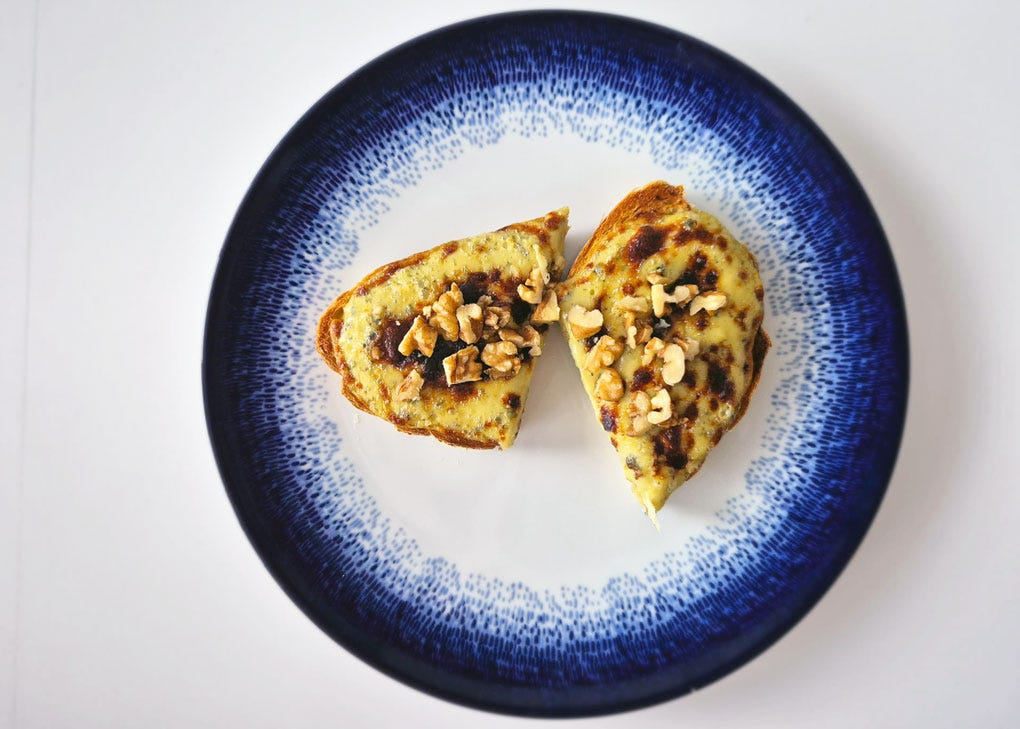
I managed to snag myself a giant wedge of blue cheese – you know I find it impossible to ignore a yellow label – at a greatly reduced price last week and it got me thinking about rarebit. There are so many versions of Welsh rarebit, some of which I’ve featured before, but I’ve never made a blue version. This was a revelation! It’s super simple to make but oh so satisfying. Ideal if you’ve still got a little bit hanging around in your fridge from Christmas.
Ingredients (serves 2)
1 tsp butter
1 tsp flour
100ml milk
100g Welsh blue cheese, crumbled
40g Welsh cheddar, grated
1 tsp English mustard
1/4 tsp rosemary
2 big slices of crusty bread
Drizzle of Welsh honey
Handful of chopped walnuts
Method
Melt the butter in a saucepan over a high heat until fizzing, then tip in the flour and mix vigorously to combine and cook out the flour.
Add the milk bit-by-bit, stirring until it is incorporated each time.
Add the cheeses and the mustard and rosemary and mix, and gently simmer until the cheese has melted and it’s thickened. Then take it off the heat.
Very lightly toast the bread, then drizzle with the honey. Place on a baking sheet.
Top with the rarebit, which should have started to firm up a bit by now, and place under a hot grill until brown and bubbling.
Transfer to a plate and sprinkle with the chopped walnuts.
If you try the recipe out, don’t forget to tag any photos with #mywelshkitchen.
The Playlist
To me, cooking and music go hand in hand, whether that’s singing at the top of your voice using a wooden spoon as a microphone while waiting for pasta to boil, or dancing around with the oven gloves on as the oven timer counts down. Here are some ideas for your Welsh Kitchen playlist.
We’re celebrating some January birthdays this issue with two legends, Dame Shirley Bassey (aged 89) and Ivor Novello (born 133 years ago) – plus a rendition of Carol y Swper.
History Repeating by Propellerheads featuring Shirley Bassey
We’ll Gather Lilacs by Cerys Matthews (written by Ivor Novello)
Carol y Swper by Parti Cut Lloi
Bread of heaven in London
I’m delighted to say that London is getting its very own Welsh café. Bara is opening on 12 February in Peckham. The brainchild of Welsh chefs Cecily Dalladay and Zoë Heimann, Bara is a loveletter to Welsh food tradition and innovation. On the menu, you can expect a Caerphilly Cheesesteak sandwich with eight-hour, smoked Welsh beef brisket, melted Caerphilly cheese, melting onions and Blas Y Tir leeks, a Crab Rarebit made with Câr-y-Môr brown crab, Caerphilly cheese & Purple Moose beer, and of course toasted Bara Brith slathered in salty butter. I was lucky to have peek and a nibble this week, and it looks and tastes fantastic!


From the archive
Hafod and Hendre

Being a bit of a language nerd, the roots and origins of words and names always interests me. Let’s take three words beginning with ‘p’ for example. Penguin is thought to come from the Welsh pen gwyn (white head) referring to how Welsh seafarers described the birds when they first saw them. Pikelet – the crumpet-like griddle bread – is thought to get it…
What do you eat when you don’t know what to eat?

It might come as a bit of a surprise, but until the age of about 16, I was a fussy eater. I played it safe where food was involved, opting for the familiar and comforting rather than the unknown or exotic. I liked Sunday dinners (roasts), sausage, beans and chips, fish fingers, bread and butter, ham sandwiches. Talking of ham sandwiches, I must have eat…